Pre-deploy security checklist: The absolute launch readiness guide for vibe-coded AI apps.
- Focus
- Checklist
- Risk
- High
- Stack
- Supabase/Next.js
- Detection
- Ubserve Runtime Simulation
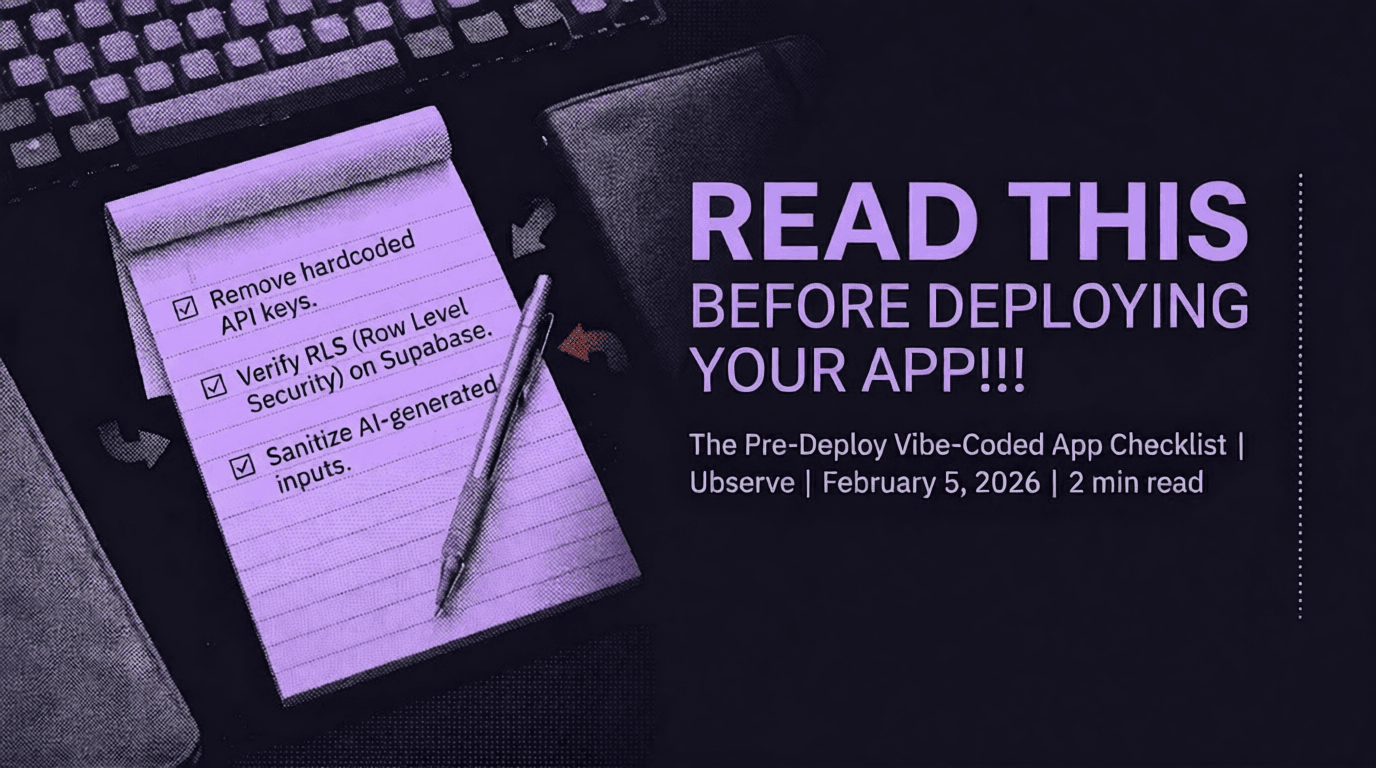
A high-intent deployment checklist to ensure your app is safe enough for launch.
Use this checklist before every release to catch the secrets, access control gaps, and API exposure issues that vibe-coded apps commonly ship with.




Secure your vibe-coded app with Ubserve
- ✓Takes less than 60 seconds
- ✓100+ security checks run through your app
- ✓Plain English explanations for each issue
- ✓AI fix prompts for every issue
Securing a vibe-coded (AI-generated) app requires treating all AI output as untrusted input until you have verified it yourself. Immediately secure it by validating authentication and authorization on the backend, removing hardcoded API keys from your .env file, enabling Row Level Security in Supabase, and running an automated scanner before going live. AI coding tools like Cursor, Lovable, and Bolt generate working code fast — but they routinely introduce the exact vulnerabilities this checklist catches.
Key Security Steps for Vibe-Coded Apps
Validate Authentication and Authorization: Ensure all access checks happen on the backend, not the frontend. Verify Role-Based Access Control (RBAC) for every API endpoint, server action, and RPC function. Never accept "the UI only shows this to admins" as an authorization model.
Handle Secrets Safely: Never hardcode API keys or service tokens in your codebase. Use environment variables and confirm they are not committed to GitHub. Search for service_role, sk_live_, and OPENAI_API_KEY before every deploy.
Enable Row Level Security (RLS): Every user-facing Supabase table needs RLS enabled with policies validated against auth.uid(). An exposed table without RLS means any authenticated user can read every row.
Use Parameterized Queries: Prevent SQL injection by ensuring all database queries are properly parameterized. AI-generated database calls frequently skip this.
Run Automated Scanning: Use a security scanner like Ubserve to catch public-surface issues before going live: exposed frontend keys, source maps, missing headers, verbose errors, CORS mistakes, auth-page cache headers, and light rate-limit signals. Use the full audit for private checks like RLS policy logic, GitHub exposure, Supabase/Firebase configuration, and auth-flow behavior.
Confirm server-only secrets stayed server-only
- Search for
service_role,sk_live_,OPENAI_API_KEY, and internal admin tokens. - Inspect environment variable exposure through
NEXT_PUBLIC_prefixes. - Verify that client bundles do not reference internal endpoints protected only by obscurity.
One recurring AI-generated edge case is a helper that accidentally promotes a server secret into a client-safe constant:
export const supabaseAdmin = createClient(
  process.env.NEXT_PUBLIC_SUPABASE_URL!,
  process.env.NEXT_PUBLIC_SUPABASE_SERVICE_ROLE_KEY!,
);
The hallucination is not subtle. The model often invents a NEXT_PUBLIC_ prefix because the code "needs to run everywhere."
Verify authorization at the mutation layer
Make sure every path answers the question: who is allowed to do this, and where is that enforced? Without proper authorization, a user can access data that belongs to someone else.
Check every:
- Route handlers
- Server Actions
- RPC functions
- Edge functions
- Background jobs
Do not accept "the UI only shows this to admins" as authorization.
Check RLS, storage, and data exposure
- Enable RLS on all user tables
- Validate policy conditions against
auth.uid() - Confirm private storage buckets are not set to public
- Review RPC functions for overly broad execution permissions
JWT payloads are useful, but they are not a permission model by themselves.
Review client-side hydration and debugging output
Hydration leaks are easy to miss because they look like harmless convenience during development.
Check for:
- Admin-only objects passed through serialized props
- Debug payloads rendered into hidden DOM nodes
- Config blobs exposing internal IDs or tokens
- User records sent to the browser unnecessarily
Confirm API and route behavior
- Auth routes reject malformed tokens
- Admin routes do not infer access from a UI role flag
- Write endpoints validate ownership before mutating
- Public APIs rate-limit or constrain abuse paths
Make the deploy observable
Before you ship, confirm you will know if the release fails securely:
- Auth failures are logged
- Billing errors are logged
- Permission denials are visible
- Important mutation paths emit useful identifiers
Final release decision
Do not ask "Does the app work?" Ask:
- Did any privileged value reach the client?
- Can one user access another user's data?
- Can a public route write or mutate unexpectedly?
- Can you explain your authorization model in one paragraph?
If you cannot answer those cleanly, the deploy is not ready.
Run a free URL scan. If it finds issues, paid plans unlock the full report, exact AI fix prompts, PDF export, and deeper audit coverage.
About the author

I'm Samuel, known online as Mr. Ballaz. I build Ubserve, a security scanner for apps built with AI tools like Cursor, Bolt, Lovable, and Supabase. Before Ubserve, I did manual security audits by hand — checking auth, exposed keys, and RLS policies one by one. Ubserve is that manual audit, automated, running in under 60 seconds instead of days.
Related resources

FAQs
How do I secure a vibe-coded app before launch?+
What are the biggest security risks in vibe-coded apps?+
How often should this checklist run?+
Who should own the checklist?+
Turn this resource into a real security check.
Review the guidance, then run the free scan to see whether this issue is actually exploitable in your app, no signup required.