Ubserve vs ScanVibe: Which Vibe Coding Scanner Finds What Matters
- Focus
- Comparison
- Risk
- High
- Stack
- Supabase/Next.js
- Detection
- Ubserve Runtime Simulation
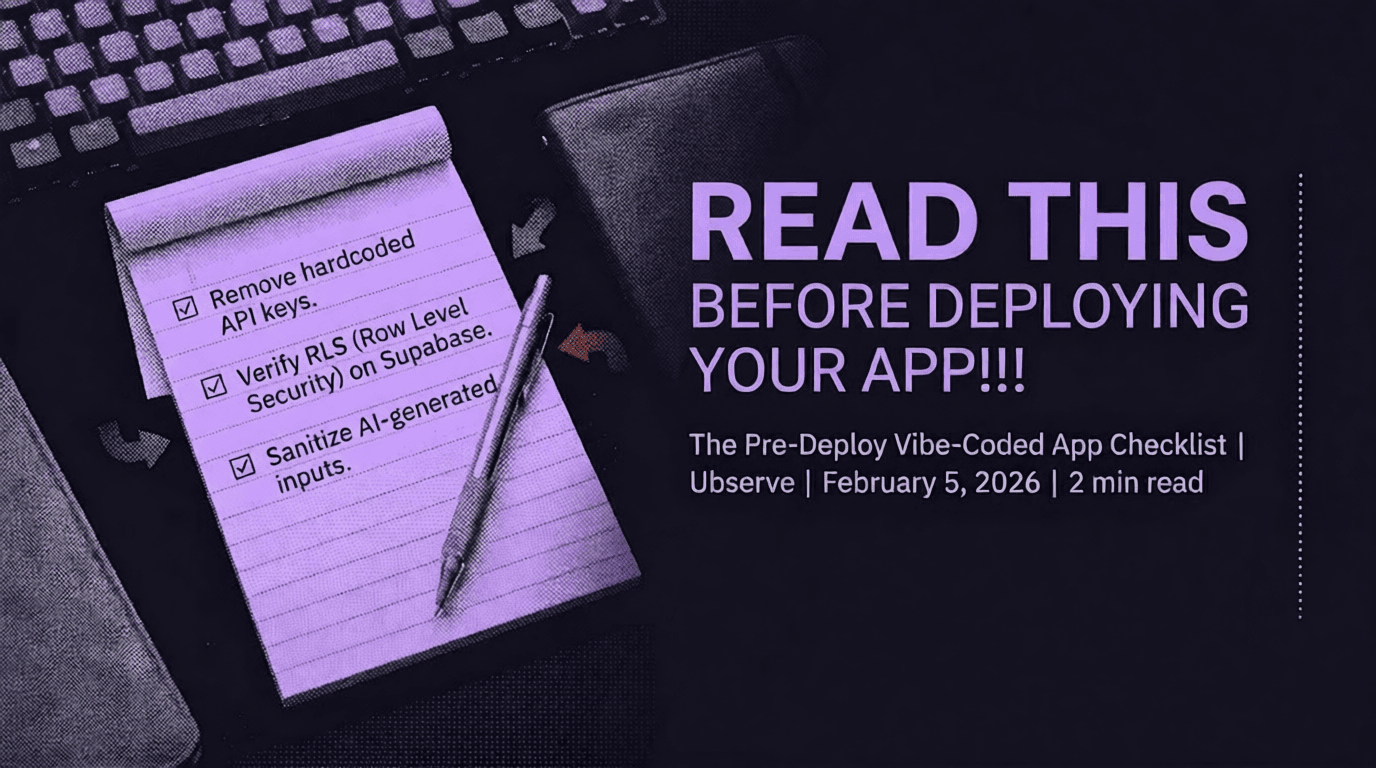
ScanVibe checks your URL. Ubserve starts with a free URL scan, then paid reports and audits unlock deeper RLS, BOLA, and service role key checks.
ScanVibe is useful for public URL checks. Ubserve starts with the public layer, then paid reports and audits add fix prompts, RLS logic, authorization checks, and service-role boundary review.




Secure your vibe-coded app with Ubserve
- ✓Takes less than 60 seconds
- ✓100+ security checks run through your app
- ✓Plain English explanations for each issue
- ✓AI fix prompts for every issue
Quick Answer: Is ScanVibe or Ubserve Better for AI-Built Apps?
Choose ScanVibe if you only need a fast outside-in URL check. Choose Ubserve if you want the same starting point, plus a paid path into full reports, exact AI fix prompts, PDF export, scan history, and deeper audit coverage for auth, RLS, GitHub, and Supabase/Firebase risk.
The important distinction is simple: a URL scan can show what the public internet can see. A full audit can check whether your app's auth, database, and code paths actually protect user data.
Both tools are black-box URL scanners, so both inherit the limits the OWASP Web Security Testing Guide describes for external testing, and both are ultimately checking the rules set by Supabase RLS.
What each scanner actually checks
| Check | ScanVibe | Ubserve URL scan | Ubserve full audit |
|---|---|---|---|
| SSL/TLS configuration | Yes | Yes | Yes |
| Security headers | Yes | Yes | Yes |
| API keys visible in JavaScript | Yes | Yes | Yes |
Public .env, .git, and sensitive files |
Yes | Yes | Yes |
| Public source map exposure | Check current scope | Yes | Yes |
| Verbose error / stack trace leaks | Check current scope | Yes | Yes |
| CORS misconfiguration | Yes | Yes | Yes |
| Auth/reset page cache headers | Check current scope | Yes | Yes |
| Light rate-limit smoke checks | Check current scope | Yes | Yes |
| RLS policy logic, not just RLS presence | No | No | Yes |
| BOLA/IDOR in API routes | No | No | Yes |
| Service role key import boundaries | No | No | Yes |
| GitHub repo and commit exposure | No | No | Yes |
| Supabase/Firebase configuration checks | Limited from URL | No | Yes |
| Auth-flow behavior with test accounts | No | No | Yes |
| Exact AI fix prompts | Check current plan | Paid report | Paid report |
| PDF report and scan history | Check current plan | Paid plans | Paid plans |
Pricing fit
Ubserve's current motion is built around conversion from risk:
| Stage | What happens |
|---|---|
| Free URL scan | No signup required. Enter a domain, get the issue count and a preview. |
| Paid report unlock | Reveals the full findings, exact AI fix prompts, PDF export, and scan history. |
| Starter | $25/mo, or $19/mo billed annually, for one production app. |
| Pro | $49/mo, or $35/mo billed annually, for frequent shippers and more projects/audit capacity. |
| One-time report unlock | $39 once, for a single scan's full report. No subscription. |
That matters because most founders do not want to pay before knowing whether anything meaningful was found. The scan creates the proof. The paid report and audit create the fix path.
Why URL scanning has a hard limit
URL scanning is useful, but it cannot inspect hidden trust boundaries.
A URL scanner can often tell whether a route exists, whether a header is missing, whether source maps are exposed, or whether a public JavaScript bundle contains suspicious strings. It cannot prove that your database policies are correctly scoped to the current user.
For example:
CREATE POLICY "read own records"
ON user_data FOR SELECT
USING (auth.role() = 'authenticated');
That policy can look fine from the outside because RLS exists. It is still unsafe if every authenticated user can read every row. The safer pattern is ownership-bound:
CREATE POLICY "read own records"
ON user_data FOR SELECT
USING (user_id = auth.uid());
Detecting that difference requires database or code-level context. That is why Ubserve separates the free URL scan from the paid full audit.
When ScanVibe is enough
ScanVibe or any lightweight URL scanner is a reasonable starting point when:
- You want a quick outside-in check before a demo.
- You only care about headers, SSL, public files, and visible bundle exposure.
- You want recurring public-surface monitoring.
- Your app is still a prototype with no real users or sensitive data.
That is real value. It just should not be confused with an authorization or database audit.
When Ubserve is the better fit
Ubserve is the better fit when:
- Your app has real users, private data, subscriptions, payments, or admin screens.
- You want to know whether the findings come with exact AI prompts to fix them.
- You use Supabase or Firebase and need to verify data access rules.
- You have GitHub code or commit history that may contain keys, logs, or unsafe patterns.
- You are close to launch and need a clear ship-or-fix decision.
The failures that hurt vibe-coded apps are usually not just missing headers. They are broken auth assumptions, weak RLS policies, exposed service keys, source maps, and routes that trust a user id from the browser.
The best sequence
- Run a free Ubserve URL scan.
- If it finds issues, unlock the full report for exact findings and AI fix prompts.
- Run the full audit when you need RLS, API authorization, GitHub, Supabase/Firebase, and auth-flow checks.
- Fix the issues, then rescan before launch.
Bottom line
ScanVibe tells you what the public internet can see. Ubserve starts there, then gives you the paid path to understand what attackers can actually do through auth, database, code, and configuration mistakes.
Run the free Ubserve URL scan. If it finds issues, unlock the full report before your users or attackers discover the same gaps.
See also: our comparison against VibeAppScanner and the full vibe coding security risks guide.
About the author

I'm Samuel, known online as Mr. Ballaz. I build Ubserve, a security scanner for apps built with AI tools like Cursor, Bolt, Lovable, and Supabase. Before Ubserve, I did manual security audits by hand — checking auth, exposed keys, and RLS policies one by one. Ubserve is that manual audit, automated, running in under 60 seconds instead of days.
Related resources


FAQs
What does ScanVibe scan?+
What does ScanVibe miss?+
What does Ubserve scan that ScanVibe does not?+
Is ScanVibe free?+
Should I use both Ubserve and ScanVibe?+
Looking for a better alternative to this tool?
Ubserve helps founders and teams validate exploitable risk in AI-built apps with attacker-first checks, clear fix guidance, and release confidence in one workflow.