What Is JWT Token Forgery and Claim Spoofing?
JWT claim spoofing occurs when token claims are trusted without robust signature, issuer, audience, and context validation.
Platform-specific guides, pre-deploy checklists, fix-focused articles, glossary entries, and direct answers designed for search, AI retrieval, and founder-level clarity.
Deep platform guides for teams shipping with Supabase, Cursor, Bolt, and Lovable. Learn where AI-built apps usually break under real security pressure.
Pre-deploy and platform-specific security checklists for AI-built apps. Use them to catch launch blockers before auth, data, and API mistakes ship live.
Straight comparisons between Ubserve, manual review, and adjacent AppSec tools. These pages help founders choose the fastest path to release confidence.
Short, quotable explanations of the security terms AI-assisted product teams keep running into. Each entry translates jargon into practical release risk.
Problem-solution guides for the vulnerabilities that repeatedly ship with vibe-coded apps. Use them to patch common auth, secret, and policy failures.
Direct answers to the security questions founders ask before shipping AI-built products. These pages focus on practical risk, not generic theory.
Product updates written as indexable release notes with implementation context and security impact. Track what changed in Ubserve and why it matters.
Story-driven security writing, launch lessons, and field notes from AI-assisted app shipping.
JWT claim spoofing occurs when token claims are trusted without robust signature, issuer, audience, and context validation.
Server actions can still ship BOLA/IDOR flaws. Ubserve now simulates actor-resource mismatch directly in action execution paths.
RLS policies often lag behind schema changes. Ubserve now flags drift patterns before they become cross-tenant data leaks.
RBAC controls by role, ABAC by attributes, and FGAC by fine-grained object/field-level policy enforcement.

Stripe secret key exposure occurs when privileged API credentials become reachable from frontend, logs, or insecure server responses.
Production-grade agent security requires strict tool permissions, context provenance controls, and runtime policy enforcement.
The OWASP LLM risk model maps practical exploit classes such as prompt injection, excessive agency, and tool-chain trust failures.
Server Actions are server-executed functions, but they still require explicit authorization and input ownership validation.
Service-role key exposure grants bypass-level access and can invalidate row-level protections if leaked to client or logs.

SAST identifies potential insecure patterns in code; DAST validates exploitability in running application behavior.
Runtime exploit simulation validates whether a vulnerability is actually exploitable in the live application behavior path.
MCP impersonation is an attack where a rogue server mimics a trusted tool endpoint to intercept or manipulate agent traffic.
Agent goal hijacking is a stateful attack that shifts an agent from authorized objective execution to attacker-directed actions.
Indirect prompt injection occurs when malicious instructions hidden in external data are executed by an agent as trusted context.
Broken access control means authenticated users can perform actions or access resources outside their intended privilege boundary.
BOLA happens when changing an object ID grants access to data or actions outside the authenticated actor's scope.
VibeAppScanner is attractive for low-cost early scanning. Ubserve is built for higher-confidence release decisions before real traffic.
Fencer.dev is broad across security layers. Ubserve is focused on release confidence for founders shipping AI-built apps.
AuditYourApp emphasizes broad scanner coverage. Ubserve emphasizes fast exploitability clarity for AI-built app releases.
StackHawk is strong for CI/CD-centered API security programs. Ubserve is strong for founder release confidence in AI-built apps.
Snyk is built for broad enterprise AppSec. Ubserve is built for founder-speed validation of real exploitability before you ship.
Manual review still matters, but it breaks down quickly when AI tools change auth, billing, and data paths faster than humans can re-review them.
RLS is the database policy layer that enforces row-by-row authorization at query time, even when API routes or frontend checks fail.
Supabase is fast to build with and easy to misconfigure when AI scaffolds auth, storage, and RPC layers without a real security model.
If a privileged key reaches the client bundle, the fix is not to hide it better. The fix is to remove the privilege from the browser entirely.
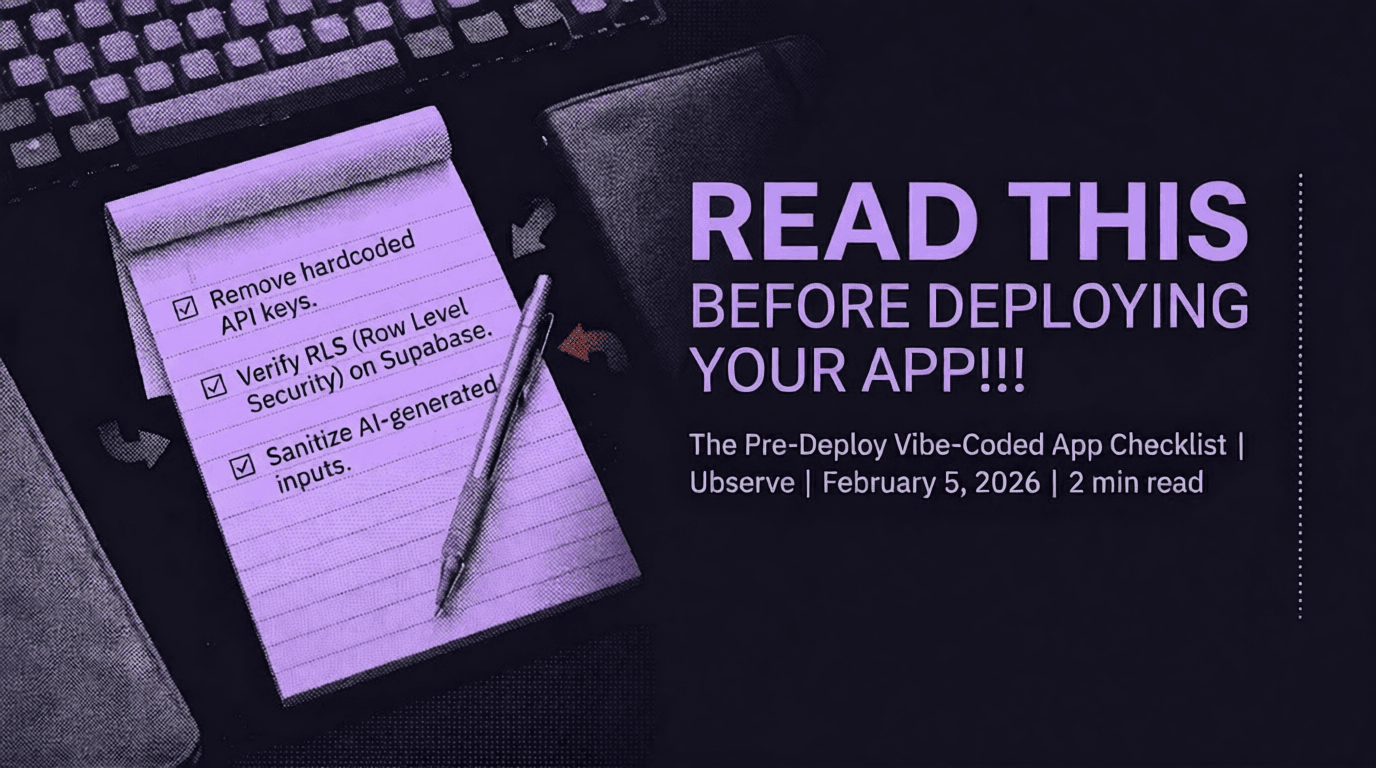
Use this checklist before every release to catch the secrets, access control gaps, and API exposure issues that vibe-coded apps commonly ship with.
Lovable accelerates product assembly. Before launch, teams still need to validate secrets, access control, server boundaries, and data exposure.
Missing RLS is one of the fastest ways to let users read data they should never see. Fixing it is less about syntax and more about your access model.
Cursor is great at reducing typing. It is not a security model. This guide shows where production risk actually appears in Cursor-assisted apps.
AI agents can help you ship production software, but they should not be trusted as the final authority on secrets, authorization, and deployment safety.
Use the library to learn the pattern, then run Ubserve to check whether it is actually exploitable in your stack.