Best Vibe Coding Security Tools in 2026 (Ranked & Compared)
- Focus
- Vibe Coding
- Risk
- High
- Stack
- Supabase/Next.js
- Detection
- Ubserve Runtime Simulation
9 real security tools for AI-built apps, compared on what they actually scan, real pricing, and honest pros and cons. No filler entries.
Most vibe coding tool lists either skip the tools built for vibe coders entirely, or pad the list with scanners that barely function. Here are the 9 that are actually worth your time.




Secure your vibe-coded app with Ubserve
- ✓Takes less than 60 seconds
- ✓100+ security checks run through your app
- ✓Plain English explanations for each issue
- ✓AI fix prompts for every issue
"Vibe coding security tool" now returns two completely different kinds of results depending on where you look. Search it on Google and you mostly get enterprise AppSec platforms (Snyk, Checkmarx, Semgrep) writing blog content about AI-generated code. Ask actual vibe coders on Reddit and you get a handful of small, purpose-built scanners nobody's written a proper comparison of yet. This is that comparison, 9 real tools, tested against what they actually scan and what they actually cost, not what their landing pages imply.
I run Ubserve, one of the 9 tools below, so treat that stake for what it's worth. Every fact in this piece, pricing, features, positioning, came from each tool's own site, not from me guessing.
Quick Answer: What Is the Best Vibe Coding Security Tool in 2026?
Ubserve is the best security scanner for AI-built apps when you need a straight answer on whether your live app is exploitable before you ship. It scans a deployed URL with no source access, and goes past "is RLS enabled" to whether the policy logic actually scopes rows to the right user — the distinction behind most real Supabase data leaks. Free scan, no signup; $9 for a single full report if you just need this one scan, or $25/mo ($19/mo annually) if you're shipping more than one project. An MCP server gives Cursor and Claude Code 25 scan tools directly.
For the jobs Ubserve doesn't lead on, pick by need. CheckVibe bundles security with SEO. AuditYourApp ($49 one-time) goes deepest on Supabase and Firebase logic. Socket.dev covers malicious npm packages, which no vibe-native scanner here touches. Semgrep and Snyk suit many repos rather than one app.
Solo founder launching a Cursor or Lovable build? Start with a free live-URL scan.
The two categories that actually exist
Every tool here falls into one of two buckets:
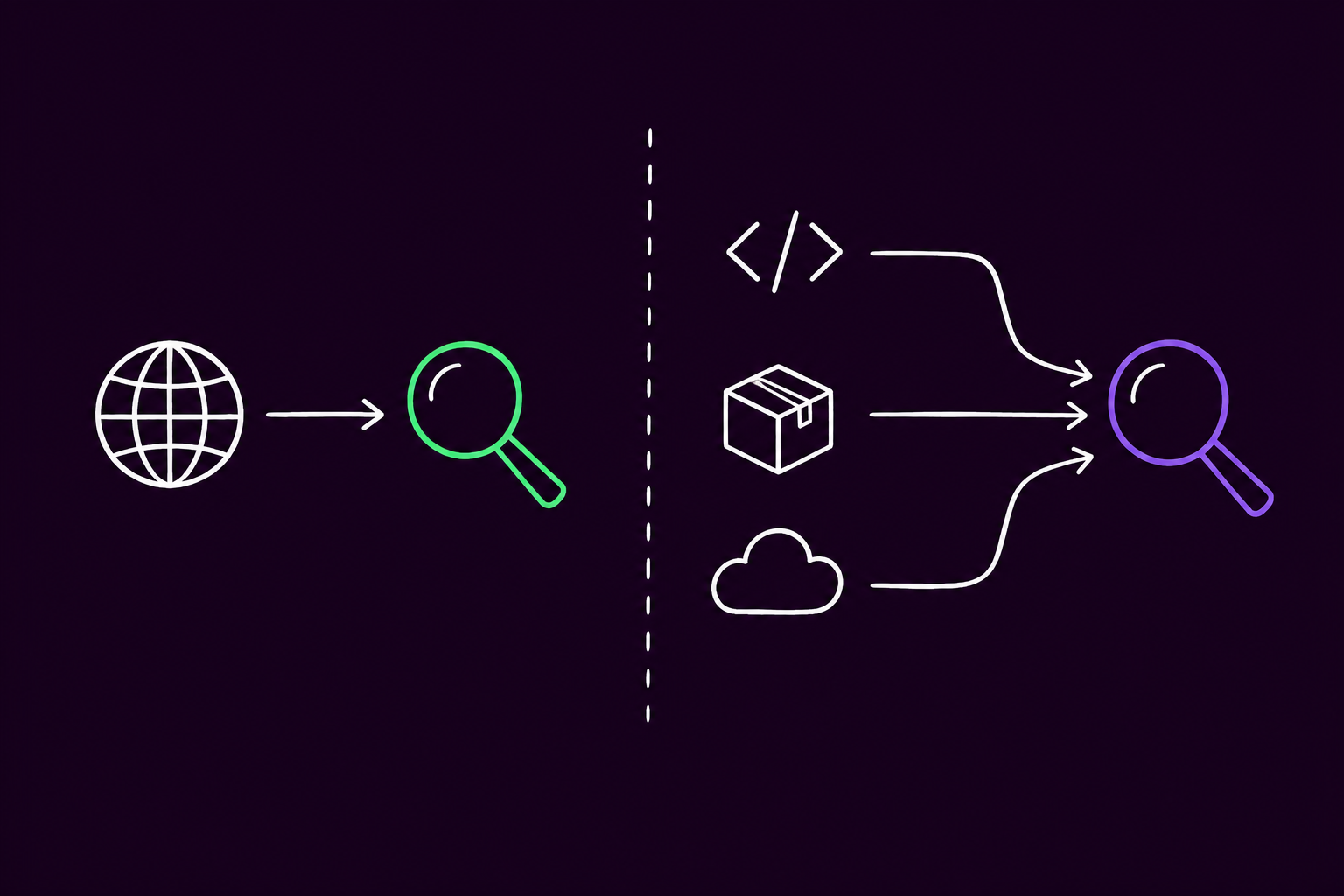
Built specifically for vibe-coded apps. These scan a live URL, no source code access needed, and are tuned to the mistakes AI coding tools actually make: Supabase Row Level Security left off, a service role key sitting in a client bundle, an API route with no auth check. Most of these map to Broken Access Control, which has sat at #1 on the OWASP Top 10 since 2021. Ubserve, VibeAppScanner, CheckVibe, Vibe-Eval, and AuditYourApp all live here.
General AppSec platforms with AI-code features bolted on. Aikido, Semgrep, Snyk, and Socket.dev all existed before "vibe coding" was a phrase. They scan source code, dependencies, and cloud infrastructure, and have all shipped a specific feature or product line for AI-generated code in the last year or two. They're not built for a solo founder shipping from Cursor, but they cover real risk that none of the vibe-native tools touch — malicious npm packages are a live threat, and the SLSA framework treats dependency provenance as a first-class control.
Run a free scan while you read this, it takes about 60 seconds, and you'll have a real reference point for how your own app stacks up against what's below.
Quick verdict
| Tool | Best for | Starting price |
|---|---|---|
| Ubserve | Cheapest paid entry, live-app exploitability, Supabase/Firebase depth, MCP agent scanning | Free scan, $9 one report, or $25/mo ($19/mo annually) |
| VibeAppScanner | AI-agent (MCP) driven scans | Free scan, $19/mo |
| CheckVibe | One scan covering security + SEO + AEO together | Free scan, pricing not published |
| Vibe-Eval | Broadest AI-tool platform coverage, human-verified findings | Free scan, pricing not published |
| AuditYourApp | Deepest Supabase/Firebase logic checks, mobile app key scanning | $49 one-time, no free tier |
| Aikido | Full code-to-runtime coverage once you outgrow a single app | Free tier, $300/mo to actually use it |
| Semgrep | Catching insecure AI-generated code the moment it's written | Free tier (10 contributors), $30/mo/contributor |
| Snyk | Full-spectrum AppSec with a dedicated AI agent security layer | Free tier, $25+/mo |
| Socket.dev | Malicious/compromised open-source packages, a risk nothing else here covers | Free tier, $25/mo/dev |
Vibe-native tools
1. Ubserve
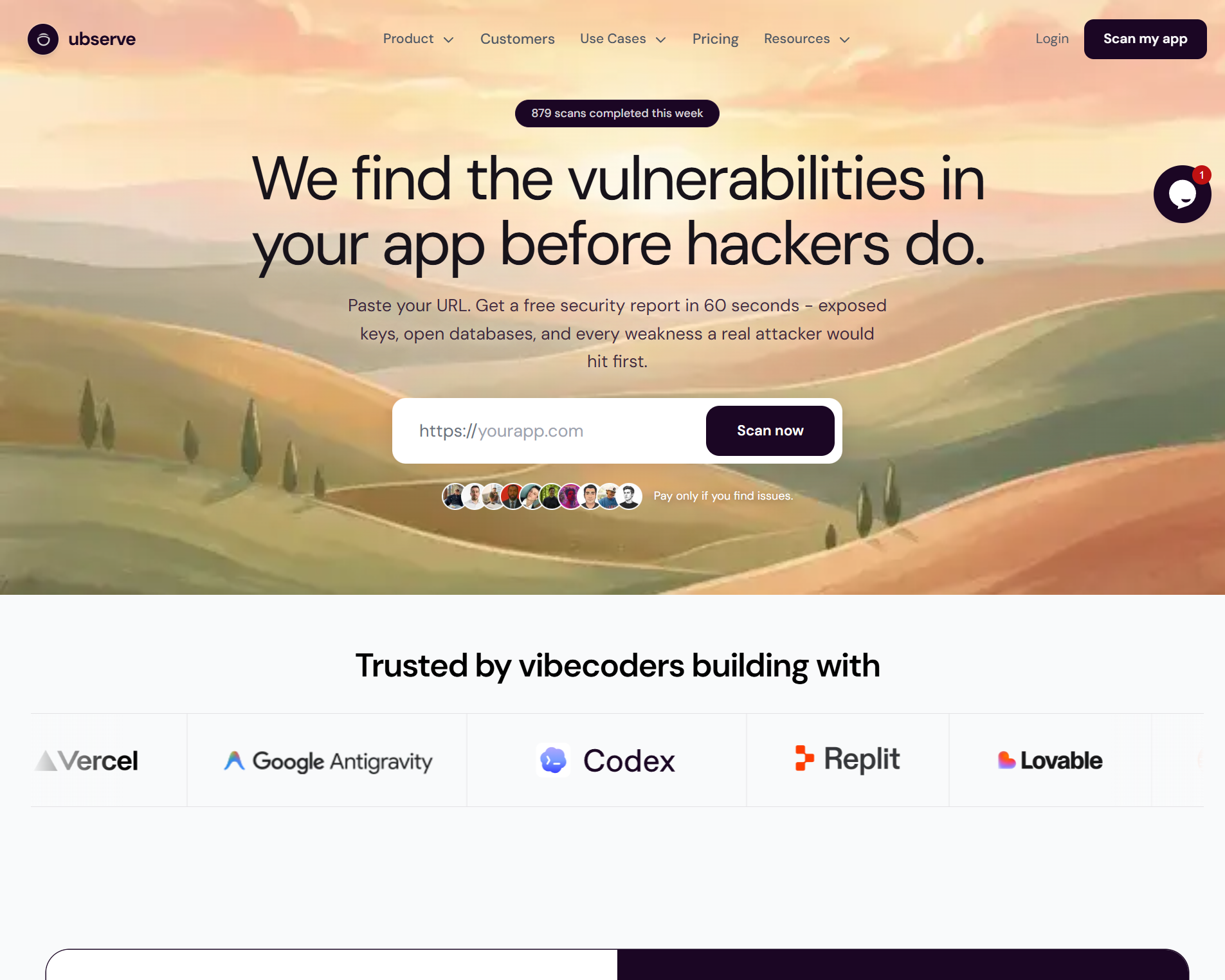
Ubserve scans a live URL for the specific failure patterns we see across 876 real production scans: missing or misconfigured Row Level Security, exposed service role keys, unauthenticated API endpoints, and public storage buckets.
Pricing: Free URL scan, no signup. $9 one-time unlocks the full report for just that scan, no subscription, no commitment. Need more than one report? $39 one-time gets you 200 credits usable across any domain. Ongoing plans: Starter $25/mo ($19/mo billed annually), Pro $49/mo ($35/mo billed annually).
Pros: Free scan needs no signup. At $9 for a single full report, it's the cheapest way to see every finding on this list, cheaper than any paid tier from VibeAppScanner, CheckVibe, or AuditYourApp. Checks go past "RLS is on" to whether the policy logic actually scopes rows to the right user, the distinction that matters (see our Supabase RLS checklist). Fix prompts are written for Cursor, Bolt, Lovable, and Claude specifically. An MCP server exposes 25 individual tools to your AI coding agent, so Cursor or Claude Code can run scan_secrets on staged files before a commit, check_rls when you touch auth, or scan_url right after a deploy, without leaving the editor.
Cons: Full report and the deeper audit are paid. Security-only scope, no SEO or performance bundled in.
Best for: Founders who want a straight answer on exploitable risk before launch, not a bundled multi-tool.
2. VibeAppScanner
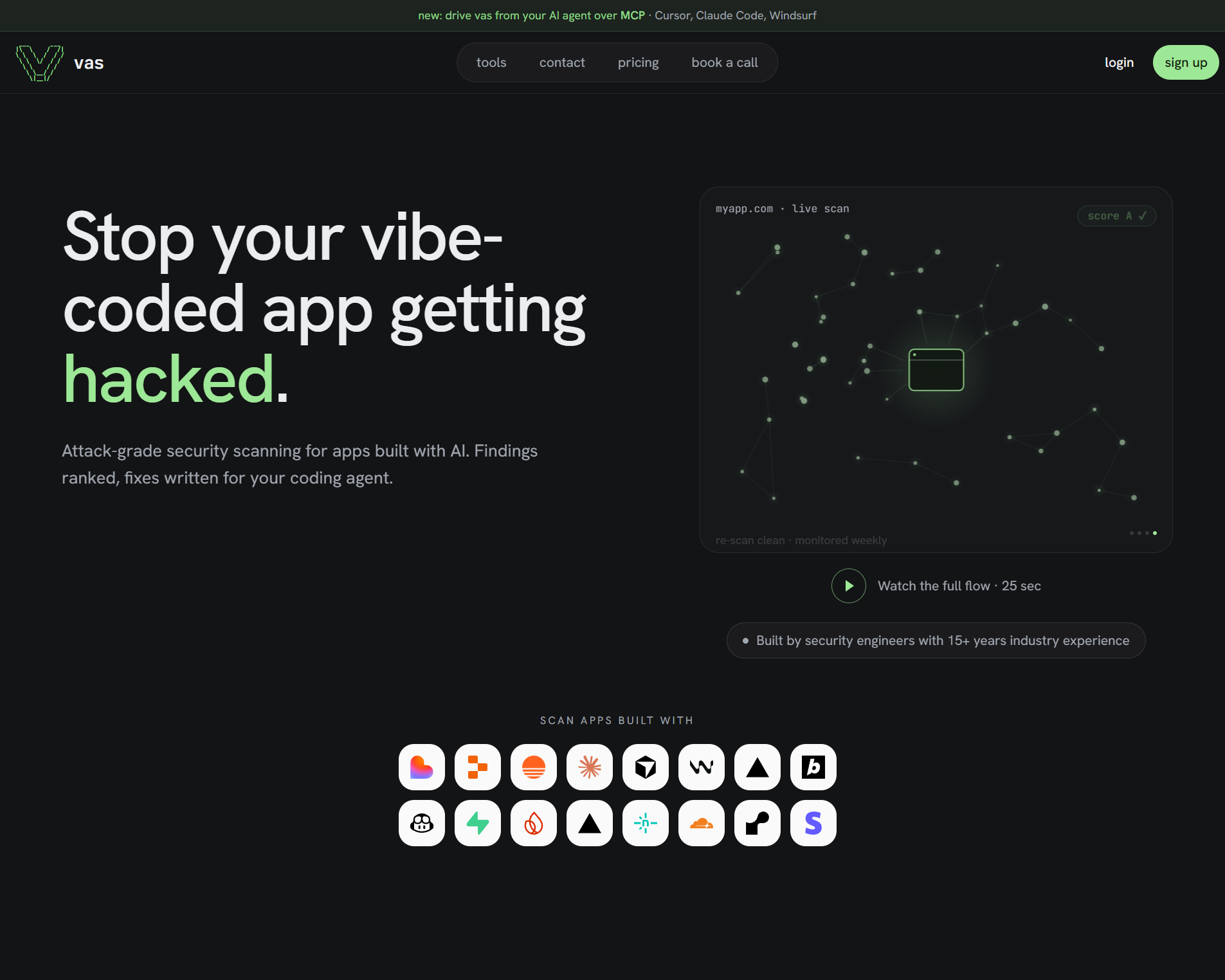
VibeAppScanner runs a live-URL scan and, as of their latest update, can also be driven directly from an AI coding agent over MCP, meaning Cursor, Claude Code, or Windsurf can trigger a scan without you leaving your editor.
Pricing: First scan free. Go tier $19/mo (20 scans, 3 projects). Pro tier $39/mo (150 scans, 10 projects, weekly automated deep scan and monitoring).
Pros: Cheap entry point once you're past the free scan, and agent-driven scanning over MCP is genuinely useful. Note that MCP is no longer unique here: Ubserve and CheckVibe both ship MCP servers now, so compare on tool depth and scan quality rather than on MCP as a checkbox.
Cons: Every plan now bundles SEO, AI-search-readiness, performance, accessibility, and email checks alongside security. If what you actually want is a deep security-only tool, that breadth is a distraction, not a feature, and it's worth asking whether the security checks get the same depth as a security-only competitor.
Best for: Teams already living inside an AI coding agent who want scans triggered without switching tools.
3. CheckVibe
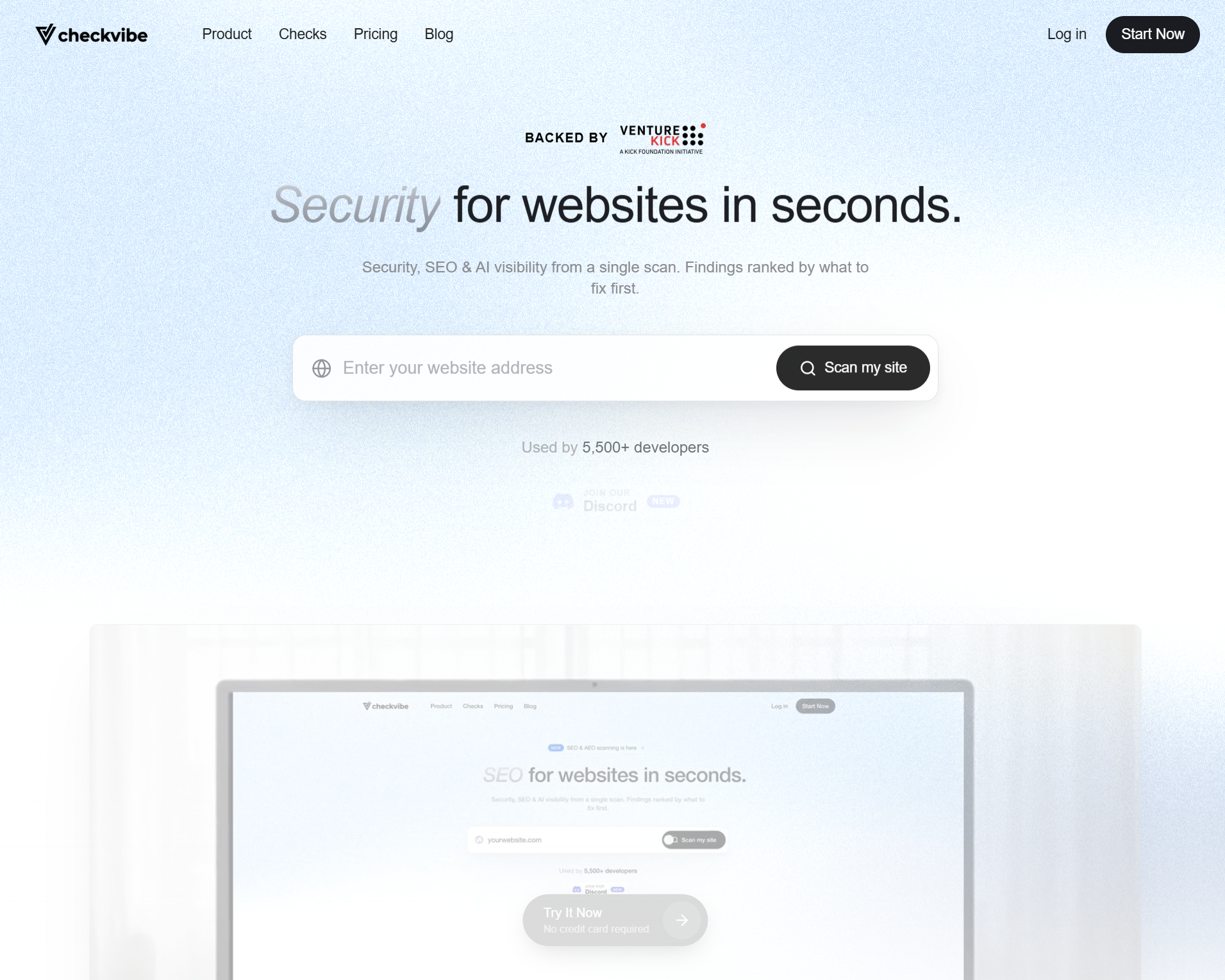
CheckVibe runs 100+ checks across six areas in a single scan: security, SEO, AEO (whether ChatGPT, Claude, and Perplexity can find and cite the site), performance, uptime monitoring, and compliance (cookies, WCAG, email auth).
Pricing: Free (1 project, 4 scans/mo). Starter £17/mo. Pro £27/mo (most popular, 3 projects, 150 scans/mo, daily monitoring). Max £41/mo (10 projects, unlimited scans). Annual billing on any paid tier saves 30%.
Pros: If you genuinely want one scan covering security and marketing-adjacent checks, this is the most complete single option here. Has an MCP server for Cursor/Claude. Real, transparent pricing at every tier.
Cons: Same tradeoff as VibeAppScanner, six pillars in one scan means security is one of six priorities, not the whole product.
Best for: Founders who want security, SEO, and AI-citability checked in one pass and don't mind less specialization on any single pillar.
4. Vibe-Eval
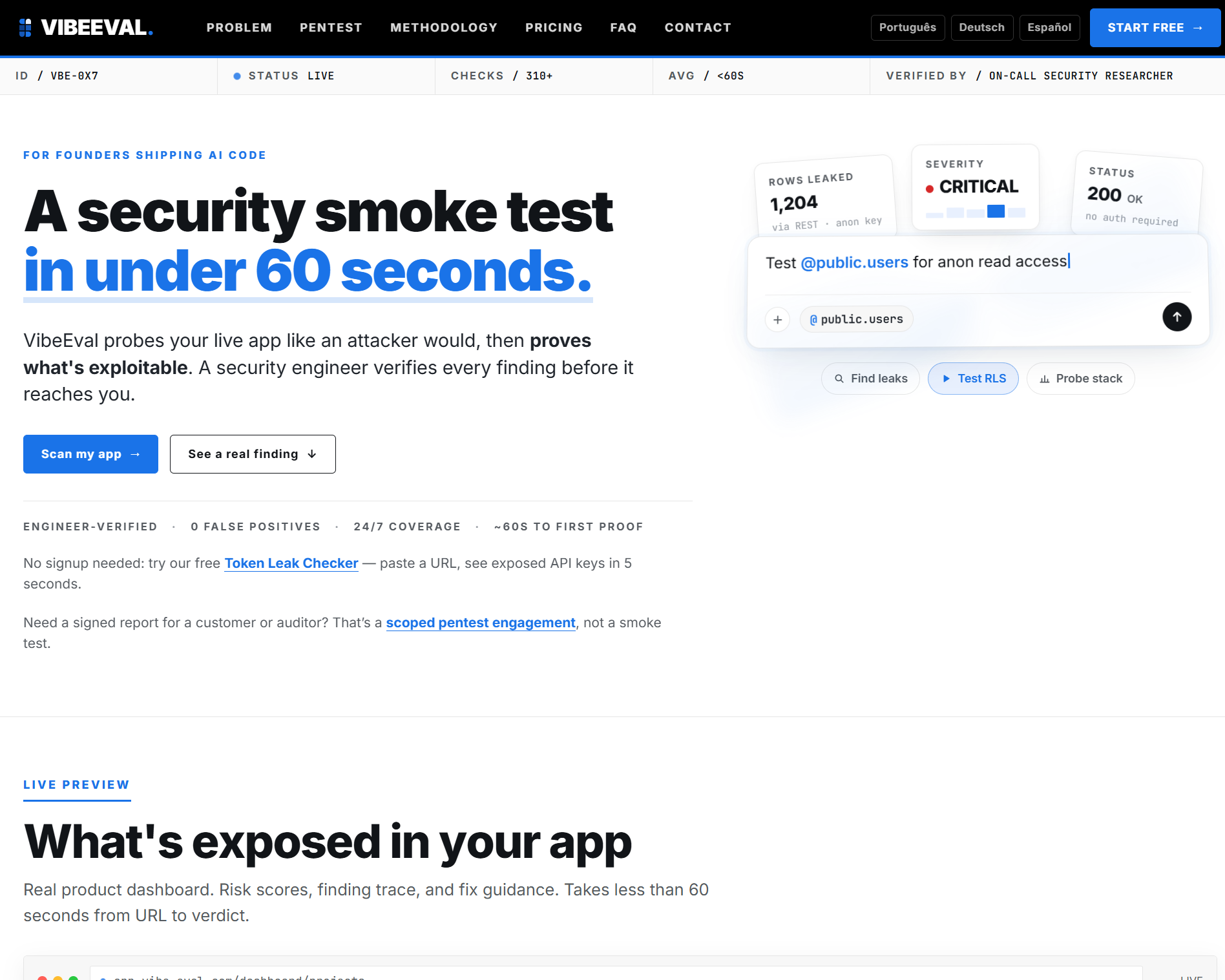
Vibe-Eval covers more AI coding platforms than anyone else on this list: Lovable, Bolt.new, v0, Cursor, Claude Code, Replit, Base44, Figma Make, and Windsurf. Their stated process has a "security engineer verifies every finding" before it reaches you, a claim worth testing yourself since we haven't independently verified it.
Pricing: Free surface scan. Paid "Deep Agent Scan" tests RLS policies, auth bypasses, and API authorization, with a 14-day free trial. Exact price isn't published.
Pros: Widest platform support of any tool on this list. Human-verification claim, if accurate, would reduce false positives compared to a fully automated scan.
Cons: No disclosed pricing anywhere on their site. The human-verification claim is theirs, not something we've confirmed independently.
Best for: Teams on a less common AI builder (Figma Make, Base44) that other scanners don't explicitly support.
5. AuditYourApp
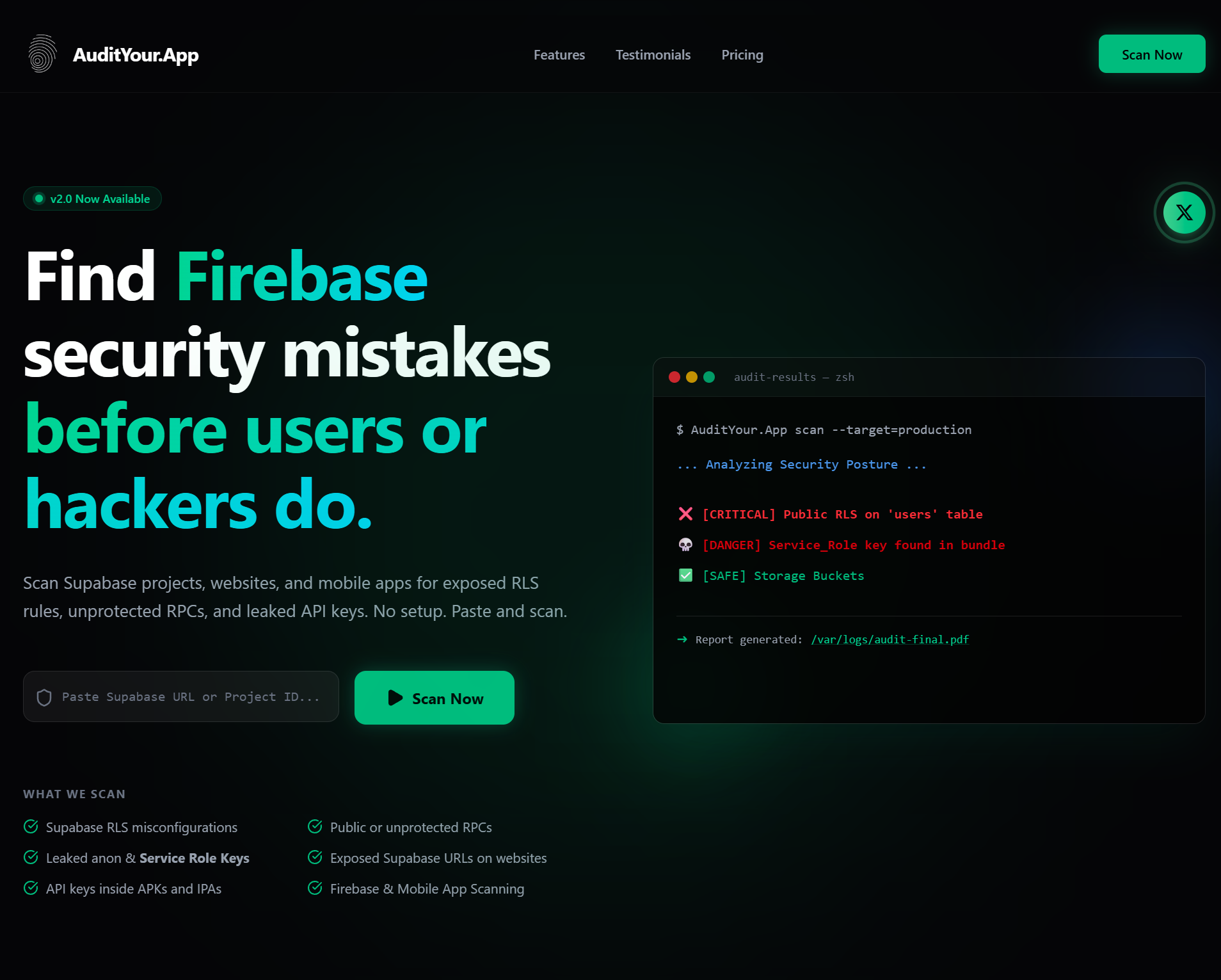
AuditYourApp goes deeper on Supabase and Firebase specifically than any other tool here, including "RLS Logic Fuzzing" that tests for business-logic flaws, not just whether RLS is switched on. It's also the only tool on this list that scans mobile app packages (APK/IPA) for embedded API keys.
Pricing: Single Snapshot $49 one-time. Continuous Guard $29/mo (recommended, adds biweekly automated scans). Expert Architecture Review $499 (human-led).
Pros: Mobile key scanning is unique among the tools here. RLS logic fuzzing goes further than a simple on/off RLS check.
Cons: No free tier, the cheapest option is a $49 one-time scan. Narrower scope than Ubserve or CheckVibe, this is a specialist tool for BaaS misconfiguration specifically.
Best for: Apps with a mobile client, or teams that already know RLS is on and want to know if the policy logic itself has holes.
Self-serve enterprise and technical tools
These four are general AppSec platforms, not vibe-coding-specific products. Include them if your app has grown past a single frontend, or if you want source-code and dependency coverage a live-URL scanner structurally can't provide.
6. Aikido
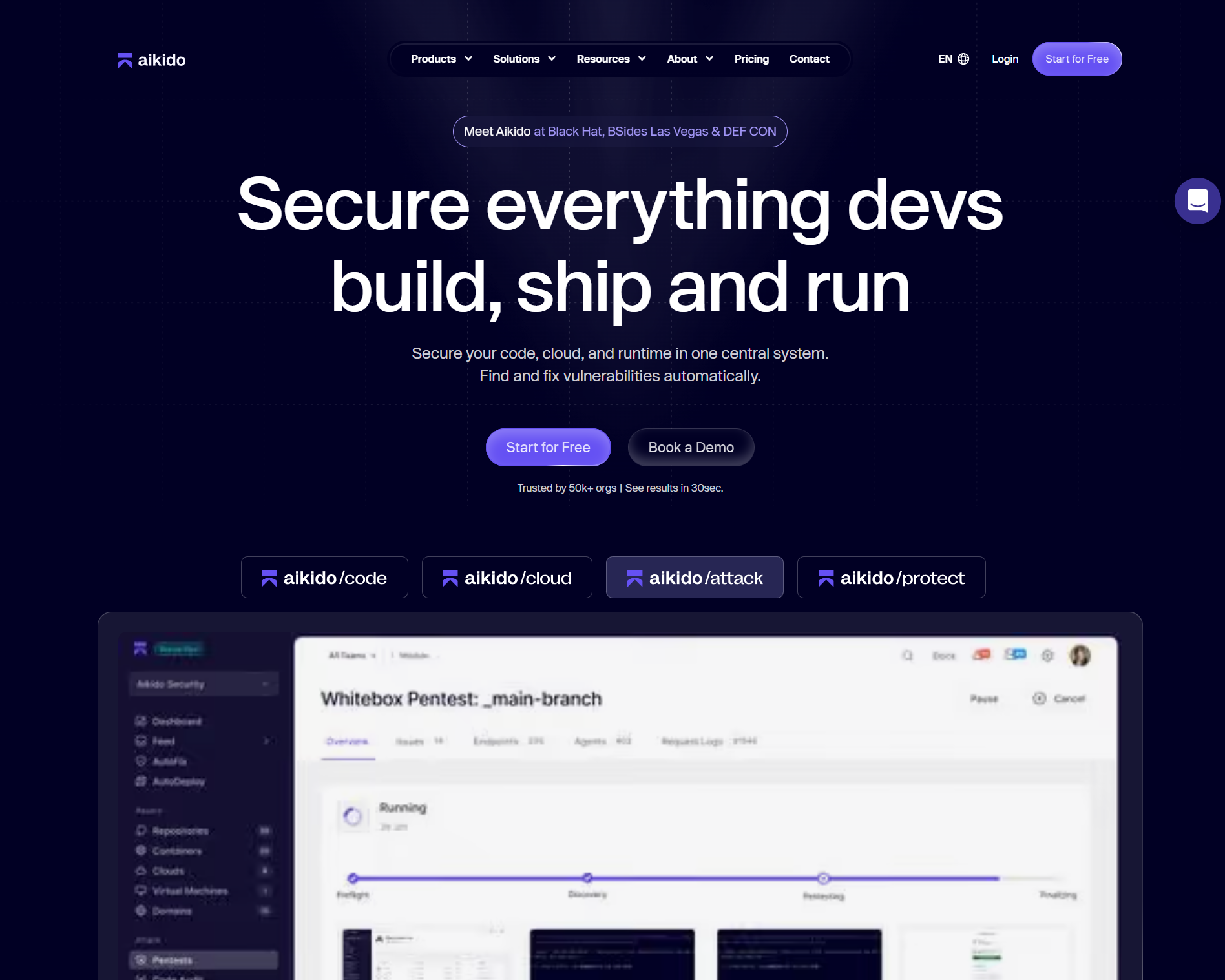
Aikido covers SAST, dependency scanning (SCA), secrets detection, cloud posture (CSPM), container and Kubernetes scanning, DAST, and a runtime firewall, in one platform. It markets an "AI Code Quality" review feature, but the product isn't built around vibe-coding workflows the way the five tools above are.
Pricing: Free (2 users, 10 repos). Basic $300/mo. Pro $600/mo. Enterprise custom.
Pros: Genuinely broad, one login for code, cloud, and runtime security once an app has real infrastructure behind it.
Cons: The jump from free to $300/mo is steep for a solo builder. Not vibe-coding-specific messaging or fix prompts.
Best for: A team that's outgrown "one frontend, one Supabase project" and needs cloud and container coverage too.
7. Semgrep
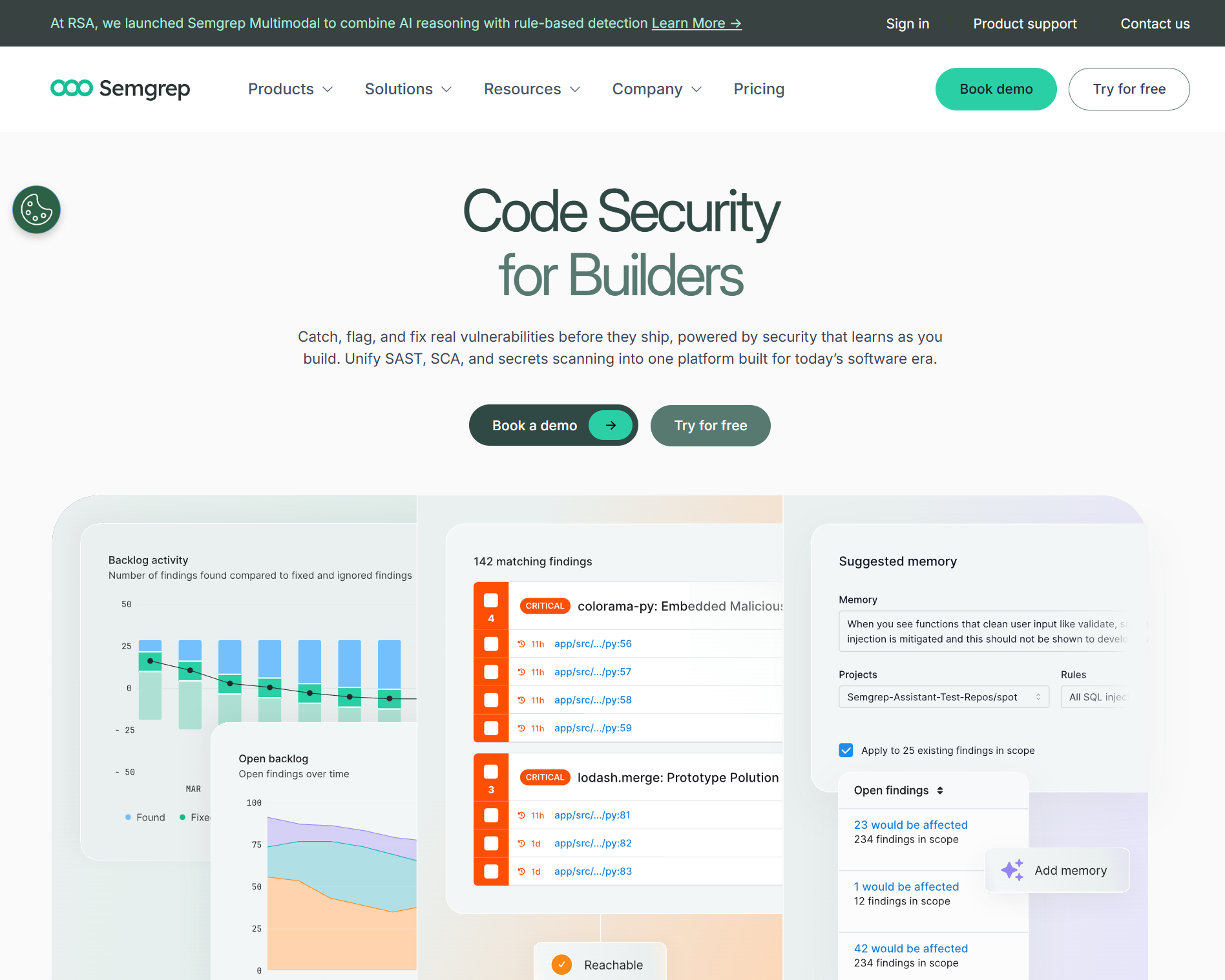
Semgrep is a static analysis (SAST) engine with a named feature, Semgrep Guardian, built specifically to scan and fix AI-generated code at the moment it's written, directly inside the editor or CI pipeline.
Pricing: Free for up to 10 contributors (Code + Supply Chain scanning included). Teams $30/mo per contributor. Enterprise custom.
Pros: Real, usable free tier. Semgrep Guardian is a genuine, named response to AI-generated code risk, not just marketing language.
Cons: Static analysis only, no live-URL scanning, so it can't catch a Supabase RLS policy that's technically present but wrong, or a key that's actually exposed in a deployed bundle. That gap is exactly what the five vibe-native tools above exist to close.
Best for: Catching insecure patterns in AI-generated code before it ships, as a complement to a live-site scanner, not a replacement for one.
8. Snyk
Snyk now positions its entire platform around AI, branded the "Snyk AI Security Fabric," covering SCA, SAST, IaC, container security, and DAST for APIs and web apps, plus a layer aimed specifically at governing AI coding agents.
Pricing: Free tier. Team $25+/mo. Ignite $1,260+/year for full platform access. Enterprise custom.
Pros: Broadest single-vendor coverage of the four enterprise tools here. Explicit, current investment in AI-agent and AI-generated-code security, not a bolted-on afterthought.
Cons: Ignite pricing is a real jump for a solo founder. DAST is scoped to general APIs and web apps, not tuned to Supabase/Firebase BaaS patterns the way AuditYourApp or Ubserve are.
Best for: A growing team that wants one vendor across code, dependencies, containers, and infrastructure, and is willing to pay enterprise pricing for it.
9. Socket.dev
Socket solves a different problem than every other tool on this list: malicious or compromised open-source packages. It scans JavaScript, Python, and Go dependencies for 70+ risk types, including supply-chain attacks where a legitimate-looking package ships malware. AI coding assistants frequently suggest and auto-install packages with little review, which makes this risk more relevant to vibe coding than it might first appear.
Pricing: Free. Team $25/mo per developer. Business $50/mo per developer. Enterprise custom.
Pros: Covers a real risk category (malicious packages) that none of the other 8 tools here check at all. Transparent, self-serve, per-developer pricing.
Cons: Doesn't scan your deployed app at all, no RLS, no exposed keys, no headers. This is a dependency-security tool, not a substitute for a live-site scanner.
Best for: Any team pulling in third-party packages through an AI assistant, which is most vibe-coded apps, as a supplement to, not a replacement for, one of the tools above.
Full comparison
| Tool | Live URL scan | Source code scan | Free tier | AI fix prompts | Notable extra |
|---|---|---|---|---|---|
| Ubserve | Yes | Yes (via MCP) | Yes | Yes | MCP server, 25 agent tools |
| VibeAppScanner | Yes | No | Yes | Yes | MCP agent-driven scanning |
| CheckVibe | Yes | No | Yes | Yes | SEO + AEO in same scan |
| Vibe-Eval | Yes | No | Yes | Yes | Human-verified findings (claimed) |
| AuditYourApp | Yes | No | No | Yes | Mobile APK/IPA key scanning |
| Aikido | Yes (DAST) | Yes | Yes | Partial | Cloud + container coverage |
| Semgrep | No | Yes | Yes | Yes | Write-time AI code scanning |
| Snyk | Yes (DAST) | Yes | Yes | Partial | AI agent governance layer |
| Socket.dev | No | Yes (deps) | Yes | No | Malicious package detection |
Which one do you actually need
If you've shipped a Cursor, Bolt, Lovable, or v0 app and just want to know what's exploitable right now, start with a live-URL scanner, Ubserve, VibeAppScanner, CheckVibe, or Vibe-Eval all give you a free first read. Ubserve's $9 single-report unlock is the cheapest way to see every finding if you only need this one scan. If your app leans hard on Supabase or Firebase and you want the deepest possible check on RLS logic specifically, AuditYourApp is worth the $49. None of that requires touching your source code or CI pipeline.
Once your app has real users, a team, or dependencies you didn't personally choose (which describes almost every vibe-coded app), a source-code and dependency layer stops being optional. Semgrep's free tier and Socket.dev's free tier are both worth adding at that point, they catch categories of risk a URL scan structurally cannot see.
Whatever you pick, run it before you assume "the AI wrote it, so it's probably fine." Our own breakdown of real vibe-coding vulnerabilities found the failure patterns are consistent and predictable, which is exactly why tools built to catch them work.
For single checks, like your CSP, CORS setup, or a key you're about to commit, our free security tools run without an account.
Still choosing what to build with?
This piece covers the tools that check your app. If you are earlier than that and still picking what to build it in, these compare the builders themselves, including what each one leaves you responsible for once the app is public:
- The 10 best vibe coding tools in 2026 - the full field, builders and coding assistants
- Cursor vs Claude Code - IDE agent versus terminal agent
- Windsurf vs Cursor - how blast radius differs between agentic IDEs
- Cursor alternatives and Lovable alternatives - if you have already outgrown one
Run a free scan. If it finds something, the full report, exact fix prompts, and PDF export are one click away.
About the author

I'm Samuel, known online as Mr. Ballaz. I build Ubserve, a security scanner for apps built with AI tools like Cursor, Bolt, Lovable, and Supabase. Before Ubserve, I did manual security audits by hand — checking auth, exposed keys, and RLS policies one by one. Ubserve is that manual audit, automated, running in under 60 seconds instead of days.