What Is JWT Token Forgery and Claim Spoofing?
- Focus
- JWT Claim Spoofing
- Risk
- High
- Stack
- Supabase/Next.js
- Detection
- Ubserve Runtime Simulation
JWT token forgery and claim spoofing are auth attacks that manipulate trust in signed identity data, granting access when verification logic is weak.
JWT claim spoofing occurs when token claims are trusted without robust signature, issuer, audience, and context validation.




Secure your vibe-coded app with Ubserve
- ✓Takes less than 60 seconds
- ✓100+ security checks run through your app
- ✓Plain English explanations for each issue
- ✓AI fix prompts for every issue
JWT token forgery and claim spoofing are authentication trust failures where a system accepts manipulated or inappropriately scoped token claims. The exploit succeeds when claims are used without full cryptographic and contextual validation.
In real systems, this often appears as middleware that checks token presence or expiry only, then trusts role or tenant claims directly. If issuer, audience, algorithm, or key source validation is incomplete, attackers can reuse or forge claims to escalate privileges.
A simple analogy: checking only the expiry date on an event wristband is not enough. You also need to confirm it came from the official organizer and matches the right venue and access zone.
Start free scan | See sample audit
What Full Validation Actually Requires
A token being present and unexpired proves almost nothing. Full validation means checking:
- Signature — was this token actually signed by your issuer's key, not a self-signed forgery?
- Issuer (
iss) and audience (aud) — was this token issued for this app, and by the identity provider you actually trust? - Algorithm — reject tokens that specify
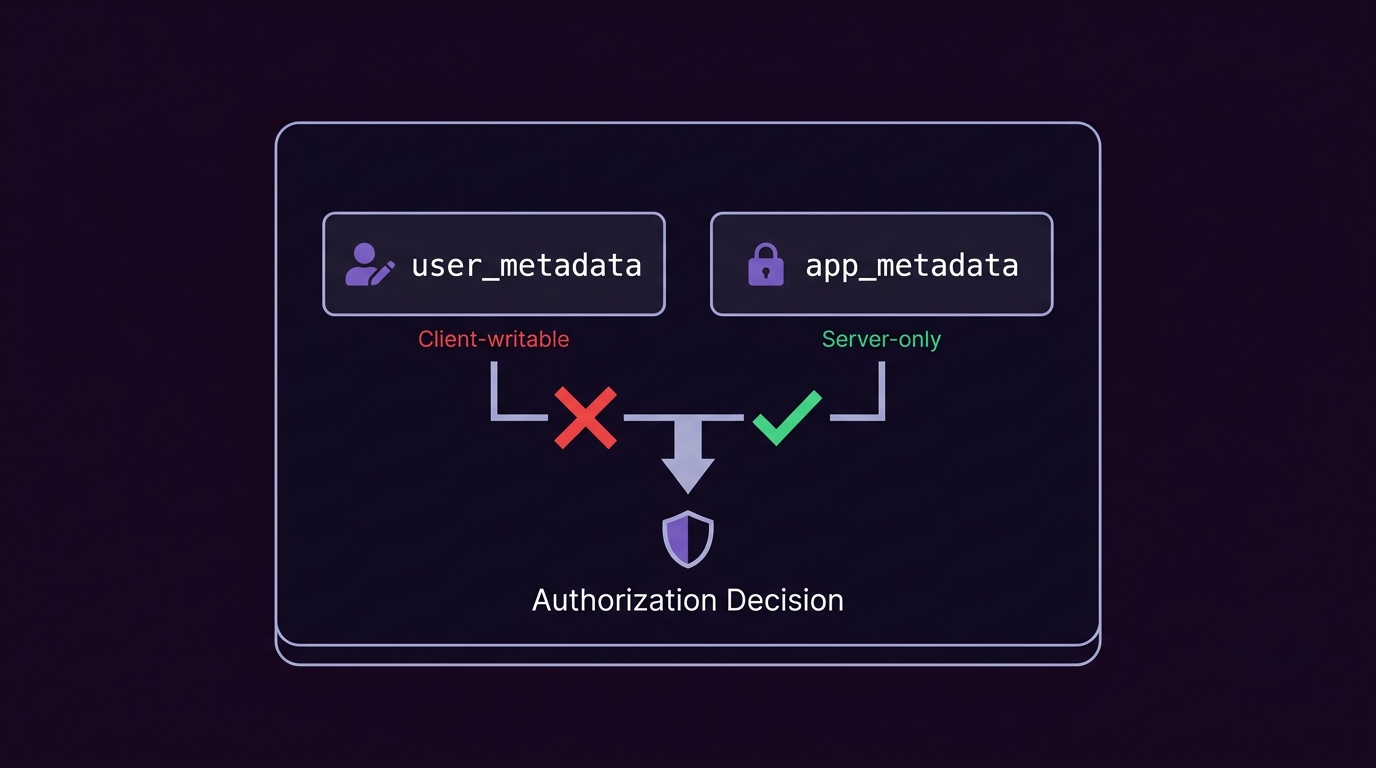
alg: noneor an unexpected algorithm; this is a classic forgery vector against loosely-configured verifiers. - Claim source — does the role or tenant claim come from a server-controlled field, or a client-writable one? This is where JWT spoofing connects directly to RBAC vs ABAC vs FGAC: a role claim is only as trustworthy as its source, and it should still be checked against object-level ownership, not used as a standalone gate.
Agentic Risk (Cursor, v0, Bolt)
AI-generated auth middleware often validates token presence and expiration but omits issuer/audience/tenant constraints. Ubserve 2026 checks found 13.2% of auth flows with claim-trust overreach.
Wrong vs. Right
// WRONG: trusts role claim directly
if (token.claims.role === "admin") allow();
// RIGHT: validate signature + iss + aud + tenant scope before role use
const claims = verifyJwt(token, { issuer, audience, jwks });
if (claims.tenantId !== sessionTenant) deny();
if (claims.role === "admin") allow();
Copy-Paste Fix Prompt for Cursor/Claude
Audit JWT verification and claim usage in my app.
1. Verify signature/issuer/audience/algorithm handling.
2. Locate all direct claim-to-permission mappings.
3. Add tenant and context consistency checks before authorization.
4. Add tests for forged/expired/mis-scoped tokens.
Return middleware patches + test suite.
Run a free URL scan. If it finds issues, paid plans unlock the full report, exact AI fix prompts, PDF export, and deeper audit coverage.
About the author

I'm Samuel, known online as Mr. Ballaz. I build Ubserve, a security scanner for apps built with AI tools like Cursor, Bolt, Lovable, and Supabase. Before Ubserve, I did manual security audits by hand — checking auth, exposed keys, and RLS policies one by one. Ubserve is that manual audit, automated, running in under 60 seconds instead of days.
Related resources
How Ubserve Applies This in Real Scans
Ubserve treats What Is JWT Token Forgery and Claim Spoofing? as a production risk, not a theory term. Our runtime simulation maps this control to attacker paths in auth, data access, and API behavior, then returns fix-ready guidance tied to your stack. OWASP-style principles are used as the baseline, but we prioritize what is actually exploitable in your live flow.
Runtime exploit simulation + behavioral authorization checks.
Clear proof path showing where trust boundaries fail.
AI-ready fix prompts and implementation-level patch guidance.
FAQs
Is checking token expiry enough?+
Why is this different from a stolen token?+
Does role in a JWT replace proper authorization checks?+
What's the most common Supabase-specific version of this bug?+
Want Ubserve to test this risk in your app?
Run a scan and get attacker-first validation, exploit evidence, and fix guidance mapped to what is jwt token forgery and claim spoofing?.