What Is Runtime Exploit Simulation?
- Focus
- Runtime Exploit Simulation
- Risk
- Critical
- Stack
- Supabase/Next.js
- Detection
- Ubserve Runtime Simulation
Runtime exploit simulation tests whether a flaw in your AI-built app can actually be abused in production, not just flagged by a static scanner.
It separates theoretical findings from real release blockers by executing attacker-like requests against your live app instead of only pattern-matching source code.




Secure your vibe-coded app with Ubserve
- ✓Takes less than 60 seconds
- ✓100+ security checks run through your app
- ✓Plain English explanations for each issue
- ✓AI fix prompts for every issue
Runtime exploit simulation is the practice of executing attacker-like payloads against a running application to verify exploitability, rather than inferring risk from source code alone. It resolves the question every release decision actually depends on: "Can this path be abused right now, by an unauthenticated or lower-privileged user?"
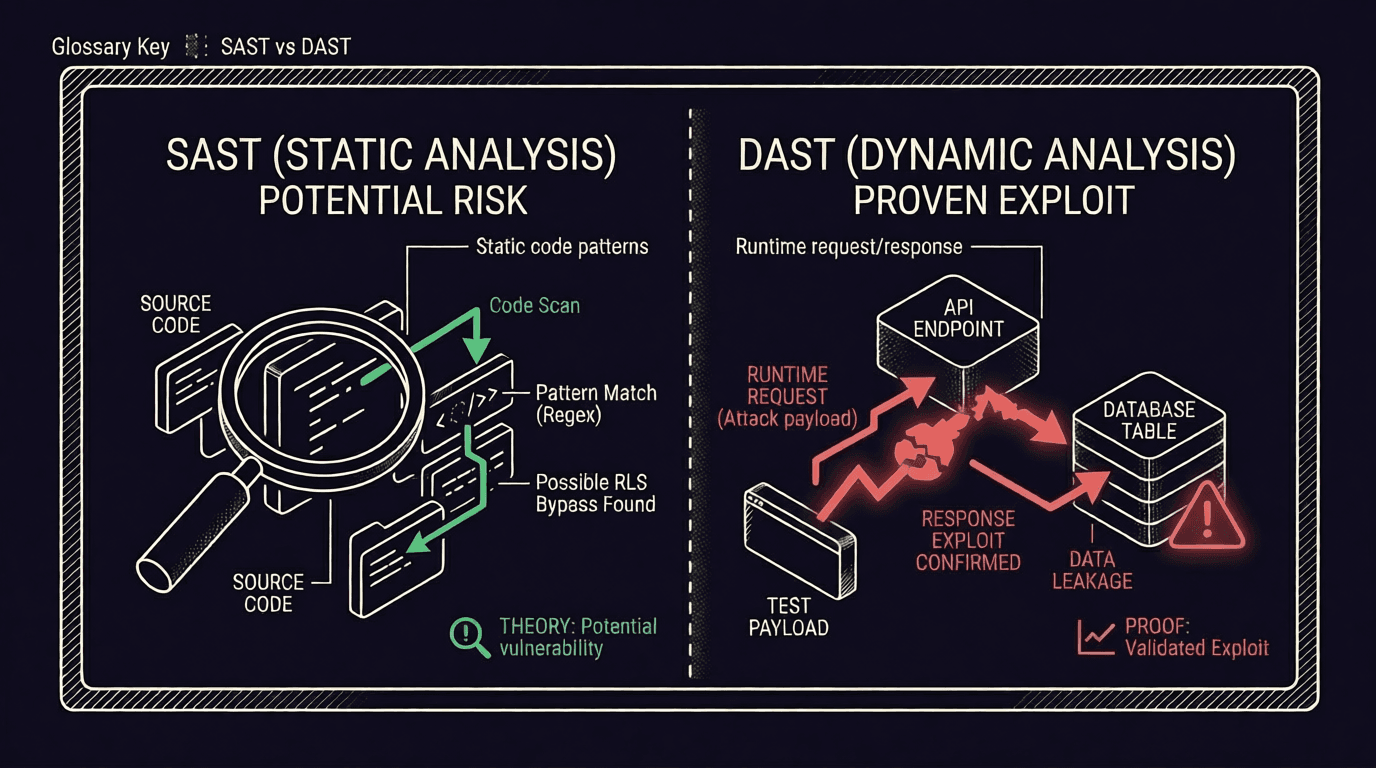
Static checks (SAST) are still useful for broad coverage — they catch obvious anti-patterns fast and cheap. But they cannot prove runtime impact in complex auth and multi-tenant data-access flows, because they never actually execute a request. Simulation validates real request paths, tenant boundaries, and observable side effects, which is what separates a theoretical finding from a real release blocker.
A simple analogy: static scanning is reading the building blueprint, while runtime simulation is running a live fire drill. You need both, but only the drill proves whether alarms, exits, and people actually behave correctly.
Start free scan | See sample audit
How Runtime Exploit Simulation Works
- Enumerate attack surface. Identify every route, server action, and mutation path that touches auth, billing, admin, or tenant-scoped data.
- Build abuse cases. Construct request variants for BOLA/IDOR (swapped user or tenant IDs), auth bypass, and policy drift — the classes of bug that only surface under real execution.
- Execute against the live app. Replay each variant as a different actor and observe the actual response, not the code path that theoretically handles it.
- Report only confirmed exploits. Filter out anything that didn't produce real unauthorized access or data exposure, so the output is a list of release blockers, not noise.
What It Catches
- BOLA/IDOR — an endpoint returns another tenant's or user's record when given a substituted ID.
- Auth bypass — a route or server action that checks for a session but never checks whether this session owns the resource being mutated.
- Secret leakage in live responses — keys or tokens that only appear once a specific request path executes, invisible to a static bundle scan.
- Policy drift — a Row Level Security policy or access rule that was correct at write-time but no longer matches the code calling it.
Runtime Exploit Simulation vs. Static Analysis vs. DAST
| Method | What it proves | Limitation |
|---|---|---|
| Static analysis (SAST) | Suspicious patterns exist in source code | Never executes anything — high false-positive rate on auth logic |
| Traditional DAST | Generic endpoint bugs (injection, XSS) under fuzzing | Doesn't test object-level authorization or actor/tenant mismatch |
| Runtime exploit simulation | A specific request, as a specific actor, is actually exploitable right now | Scoped to what it's told to enumerate — still pair with broad static coverage |
Agentic Risk (Cursor, v0, Bolt)
AI-generated stacks produce more logic-layer issues than syntax-layer issues. Ubserve 2026 internal findings show 43% of high-severity issues were invisible to pattern-only checks but confirmed under runtime simulation.
Where This Applies in Practice
Ubserve extends runtime exploit simulation into feature-specific coverage as new failure patterns show up in the wild. The most common one right now is Next.js Server Actions: session checks that verify someone is logged in but never bind the mutation to that specific actor's resources. See how runtime exploit simulation now covers Next.js Server Actions for the actor-to-object authorization checks Ubserve runs on every scan.
Wrong vs. Right
WRONG: "No findings in static scan => safe to launch"
RIGHT: "Static scan + runtime exploit simulation + authorization verification"
Copy-Paste Fix Prompt for Cursor/Claude
Generate a runtime exploit simulation plan for my app.
1. Enumerate critical routes: auth, billing, admin, tenant data.
2. Build abuse cases for BOLA/IDOR, auth bypass, secret leakage, and policy drift.
3. Execute request variants with tenant/user mismatch UUIDs.
4. Report only confirmed exploit paths and fix patches.
Return test scripts + remediation diffs.
Run a free URL scan. If it finds issues, paid plans unlock the full report, exact AI fix prompts, PDF export, and deeper audit coverage.
About the author

I'm Samuel, known online as Mr. Ballaz. I build Ubserve, a security scanner for apps built with AI tools like Cursor, Bolt, Lovable, and Supabase. Before Ubserve, I did manual security audits by hand — checking auth, exposed keys, and RLS policies one by one. Ubserve is that manual audit, automated, running in under 60 seconds instead of days.
Related resources
How Ubserve Applies This in Real Scans
Ubserve treats What Is Runtime Exploit Simulation? as a production risk, not a theory term. Our runtime simulation maps this control to attacker paths in auth, data access, and API behavior, then returns fix-ready guidance tied to your stack. OWASP-style principles are used as the baseline, but we prioritize what is actually exploitable in your live flow.
Runtime exploit simulation + behavioral authorization checks.
Clear proof path showing where trust boundaries fail.
AI-ready fix prompts and implementation-level patch guidance.
FAQs
How is runtime simulation different from static scanning?+
Is runtime exploit simulation the same as DAST?+
Is runtime exploit simulation the same as penetration testing?+
What does runtime exploit simulation catch that static analysis misses?+
Want Ubserve to test this risk in your app?
Run a scan and get attacker-first validation, exploit evidence, and fix guidance mapped to what is runtime exploit simulation?.