What Is SAST vs DAST for AI-Built Apps?
- Focus
- SAST vs DAST
- Risk
- High
- Stack
- Supabase/Next.js
- Detection
- Ubserve Runtime Simulation
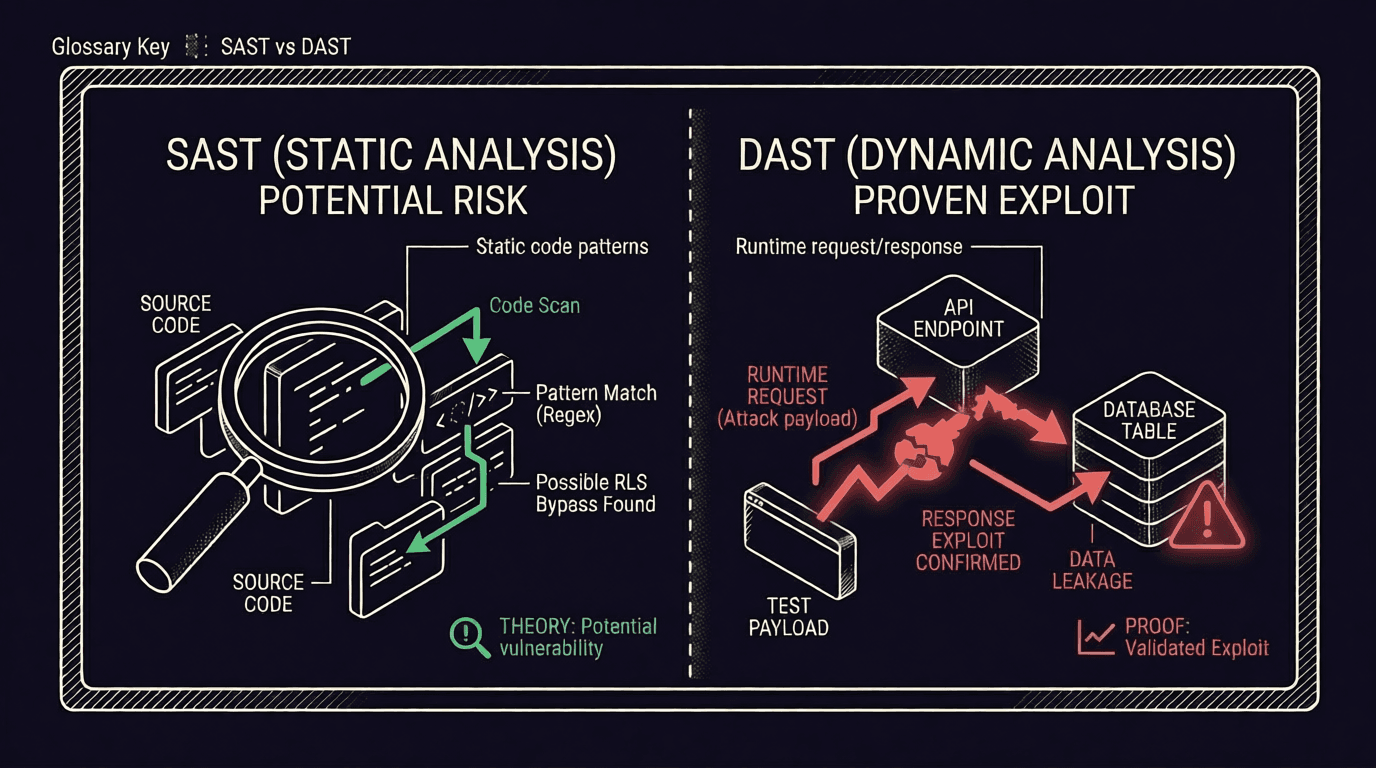
SAST vs DAST is a security testing comparison that separates code analysis from live exploit validation. AI-built apps usually need both to catch every gap.
SAST identifies potential insecure patterns in code; DAST validates exploitability in running application behavior.




Secure your vibe-coded app with Ubserve
- ✓Takes less than 60 seconds
- ✓100+ security checks run through your app
- ✓Plain English explanations for each issue
- ✓AI fix prompts for every issue
SAST analyzes source code for insecure patterns without executing it. DAST tests a running app to confirm whether an attacker can exploit behavior in production-like conditions.
For AI-built apps, this distinction matters more because generated code often looks structurally correct while still failing business-logic authorization paths at runtime. Founders should treat SAST as early signal and DAST/runtime testing as release proof.
A non-technical analogy: SAST is proofreading a script for mistakes, while DAST is performing the play on stage to see where the scene actually breaks in front of an audience.
Start free scan | See sample audit
Where Each Method Actually Catches Something
| Method | Runs against | Catches | Misses |
|---|---|---|---|
| SAST | Source code, no execution | Insecure patterns, known-bad dependencies, obvious anti-patterns | Anything that depends on runtime state or a second tenant's data |
| Traditional DAST | Running app, fuzzed inputs | Generic endpoint bugs (injection, XSS, malformed input handling) | Object-level authorization — it doesn't know what "your own data" means |
| Runtime exploit simulation | Running app, actor-aware requests | BOLA/IDOR, auth bypass, policy drift — confirmed exploitable, not theoretical | Scoped to what it's told to enumerate |
Ubserve runs the third row as its core detection method — see what runtime exploit simulation is and how it works for the full methodology, including how it differs from generic DAST fuzzing.
Agentic Risk (Cursor, v0, Bolt)
In AI-built stacks, generated logic often passes static checks while failing runtime authorization boundaries. Ubserve 2026 data indicates 2.1x more launch-blocking findings were confirmed in runtime tests than in static-only triage.
Wrong vs. Right
WRONG: SAST-only release decision for AI-generated auth/data paths
RIGHT: SAST for breadth + DAST/runtime simulation for launch confidence
Copy-Paste Fix Prompt for Cursor/Claude
Create a combined SAST+DAST security workflow.
1. Keep static checks for dependency/code hygiene.
2. Add runtime exploit simulation for auth, billing, and tenant data routes.
3. Fail release if confirmed high-risk exploit paths remain.
4. Output CI steps and local verification scripts.
Return YAML + test commands.
Run a free URL scan. If it finds issues, paid plans unlock the full report, exact AI fix prompts, PDF export, and deeper audit coverage.
About the author

I'm Samuel, known online as Mr. Ballaz. I build Ubserve, a security scanner for apps built with AI tools like Cursor, Bolt, Lovable, and Supabase. Before Ubserve, I did manual security audits by hand — checking auth, exposed keys, and RLS policies one by one. Ubserve is that manual audit, automated, running in under 60 seconds instead of days.
Related resources
How Ubserve Applies This in Real Scans
Ubserve treats What Is SAST vs DAST for AI-Built Apps? as a production risk, not a theory term. Our runtime simulation maps this control to attacker paths in auth, data access, and API behavior, then returns fix-ready guidance tied to your stack. OWASP-style principles are used as the baseline, but we prioritize what is actually exploitable in your live flow.
Runtime exploit simulation + behavioral authorization checks.
Clear proof path showing where trust boundaries fail.
AI-ready fix prompts and implementation-level patch guidance.
FAQs
Should founders choose SAST or DAST?+
Is DAST the same as runtime exploit simulation?+
Why does SAST alone miss so much in AI-generated code?+
What's a practical CI setup that uses both?+
Want Ubserve to test this risk in your app?
Run a scan and get attacker-first validation, exploit evidence, and fix guidance mapped to what is sast vs dast for ai-built apps?.